

Cultivating futures
Experiences to nurture potential, imagine futures and build skills for tomorrow
Today’s schools are not merely called upon to impart knowledge, but to support children and young people in developing the skills that enable them to navigate complexity, cope with change and build meaningful relationships with themselves and others.
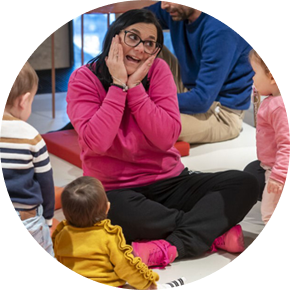
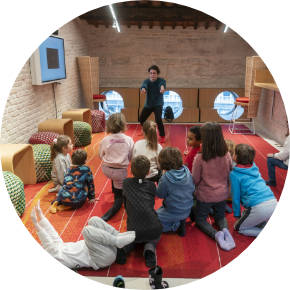
It is from this premise that Cultivating Futures, the educational programme of The Home of The Human Safety Net, was born: an ecosystem of experiential workshops that weaves together play, creativity, art, storytelling, Futures Literacy, sustainability and the development of human potential.
The entire programme takes its inspiration from the interactive exhibition A World of Potential, based on Positive Psychology and the character strengths that Martin Seligman and Christopher Peterson used as a starting point to develop a comprehensive map of human potential. Our workshops are designed to guide pupils through three key growth experiences: discovering one’s own potential, building our collective potential and understanding the impact our potential can have on the community. A journey designed to cultivate and explore personal strengths such as curiosity, creativity, leadership, hope, kindness, teamwork, social intelligence and the ability to imagine new possibilities.
The entire programme is in line with key national and international pedagogical frameworks: Law 22/2025, which introduces the development of non-cognitive and cross-curricular skills into the school curriculum; the Life Skills promoted by the World Health Organisation; the new Guidelines for Civic Education; the objectives of the 2030 Agenda promoted by ASviS; Futures Literacy, recognised by UNESCO as one of the fundamental literacies of the 21st century; and the national Ecosistema Futuro project, which promotes the development of forward-thinking and a culture of sustainability.
In this educational context, it becomes essential not only to learn how to solve problems, but also to envision possible futures, by developing critical thinking, creativity, adaptability, collaboration and planning skills. This is why the workshops help pupils to cultivate what Futures Studies refers to as dense thinking: the ability to interpret the present as a space rich in connections, in which every choice has an impact on people, communities and future generations.
This perspective now finds an important foundation in the Italian Constitution, which, with the amendment to Article 9, has included the protection of the environment and ecosystems ‘also in the interests of future generations’ amongst its fundamental principles.
The activities employ experiential, cooperative and interdisciplinary methodologies that transform students into active participants in their own learning, through games, role-play, storytelling, art workshops, collaborative writing, gamification, future exploration and collaborative design.
At the heart of the entire programme lies the trialogical method of learning, which integrates three complementary dimensions: personal experience, dialogue with others and the co-creation of shared artefacts, ideas and products.
These initiatives have been developed thanks to the collaboration between Baba Jaga – A2030, Centro Studi BarchettaBlu, Kid Pass and APOI – Associazione Professional Organizers Italia.