


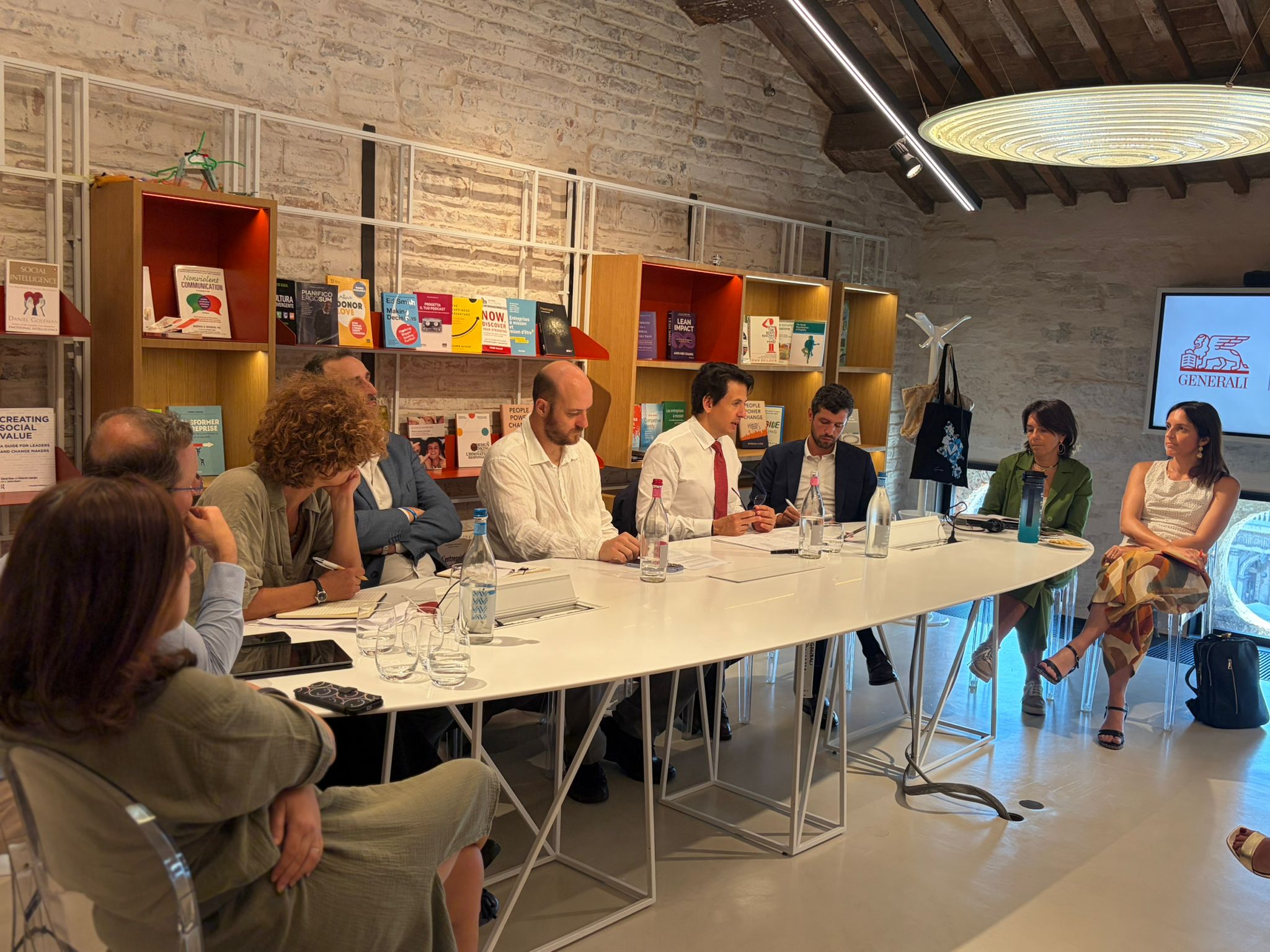
This was the central question behind The Missing Conversation: Finding Common Ground on Migration, a roundtable hosted by The Home of The Human Safety Net together with the Institute of International Affairs and Second Tree during Refugee Week Italy.
The discussion brought together Alessia Di Pascale (Full Professor, Università Statale di Milano), Roberto Lancellotti (author of Dialogue on Immigration and former INPS Board Member), Camilla Orlandi (Head of Migration, ANCI - National Association of Italian Municipalities), Claudia Pasotti (National Lead, Pathways International), Andrea Pecoraro (Senior Associate, UNHCR), Stefano Rovelli (Programme and Social Innovation Manager, The Human Safety Net), Marco Simoni (Director, Institute of International Affairs), Simona Torre (General Director, Accenture Foundation)
Although each participant approached the topic from a different perspective and institutional mandate, one shared conclusion emerged: Italy needs regular, safe and well-managed migration pathways.
Moving beyond polarization
A recurring theme throughout the discussion was the growing recognition that the current public conversation has reached an impasse.
For too long, migration has been framed primarily as a moral or ideological issue, making constructive dialogue increasingly difficult. Facts, data and evidence remain essential, but they have often proved insufficient to bridge political divides or build public consensus.
At the same time, migration is also an economic and demographic issue. An ageing population, labour shortages and growing demand for skills mean that international mobility is becoming central to the country's future—not only to migration policy.
Recognising this broader perspective does not diminish the importance of human rights. Rather, it expands the conversation by acknowledging the multiple dimensions of migration.
From migration to work
Another key takeaway was the role of employment as one of the strongest drivers of integration.
Experiences such as labour pathways show that structured employment opportunities benefit both refugees and host communities. Access to work enables people to become self-reliant more quickly, contribute to local economies and build meaningful connections within the communities where they live.
Framing the discussion around the right to work, rather than migration itself, may also create space for broader consensus, bringing together actors who do not traditionally work side by side—including businesses, humanitarian organizations, public institutions and local authorities.
Building a shared narrative
While there is growing alignment around practical solutions, participants acknowledged that communication remains one of the greatest challenges.
Today, different strategies coexist. Some believe that expanding safe migration pathways requires keeping a low public profile to avoid fuelling political tensions. Others argue that the right to mobility should be openly defended and communicated.
Both approaches pursue similar goals, yet they often operate in parallel rather than in conversation with one another.
Participants highlighted the need for a more inclusive narrative—one that moves beyond the language of crisis and emergency while acknowledging economic needs, human rights, labour market realities and the interests of local communities.
The growing role of the private sector
One of the most significant shifts discussed during the roundtable was the increasing involvement of businesses.
Companies are becoming important partners in creating employment opportunities for refugees, helping move the conversation beyond humanitarian assistance towards long-term social and economic inclusion.
This perspective challenges persistent stereotypes by recognising refugees not only as people in need of protection, but also as workers, professionals and contributors to local communities.
Continuing the conversation
The discussion was not intended to produce a single solution. Instead, it created space for voices that rarely have the opportunity to engage with one another.
What emerged was a clearer understanding that common ground already exists. Across sectors, there is broad agreement on the need for safe and legal migration pathways, stronger collaboration between public and private actors, and communication that reflects the complexity of migration rather than reinforcing polarization.